How do you prevent or limit meal spikes? It doesn’t take a closed loop artificial pancreas; it takes an understanding of insulin timing and the impact on your body.
I’ve written before about why getting insulin going in your body before meal carbs kick in is so important. You can read that really long post here. And I’ve written a slightly shorter post explaining how to do “eating soon mode” to achieve insulin activity peaking when you eat, without causing lows. But recently, I quickly scratched together an illustration to show the difference in the timing and outcomes between the “eating soon mode” approach compared to a traditional “pre-bolus” approach, and after receiving feedback that these images were helpful, decided to post them here.
(Again, for more context, read this post on how to calculate your eating soon amount; and this post for more of the science behind it and how we discovered this method 2+ (!) years ago. And as always, your diabetes may vary; I’m not a doctor; etc. but this is something that when applied consistently smooths out meal spikes, even when eating high fat or high protein or high carb or any kind of meal.)
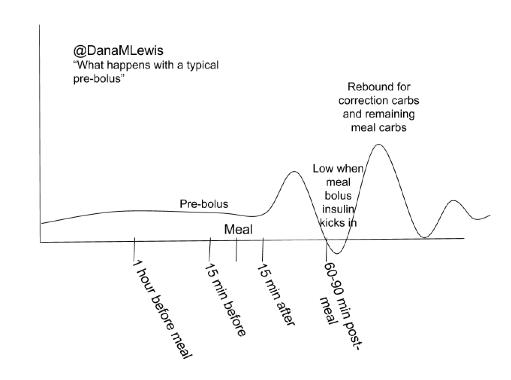
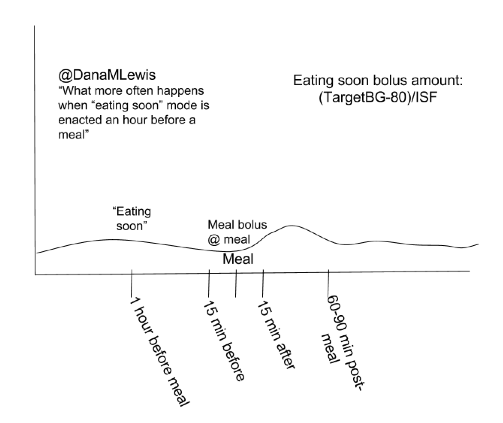
*Note – the calculation of (TargetBG-80)/ISF is assuming that you have already corrected to your normal target, i.e. 100 or 120.
Comments
7 responses to “Picture this: How to do “eating soon” mode”
[…] of insulin timing in your body, especially at meal times. Using techniques like “eating soon mode” will dramatically help anyone, with or without a closed loop, reduce and limit severity of […]
[…] do to help with those morning rises. I often do a temporary target down to 80 mg/dL (a la “eating soon” mode) once I spot the rise, but that’s after it’s already started and very […]
[…] to achieve no-hypoglycemia and 80% time in range with medium carb meals (and high-carb meals with Eating Soon mode etc.). So, let’s call that a 3 (out of […]
[…] note – no eating soon required. No early bolus or pre-bolus. Just single button press as I stick food in my […]
Thanks for all your great work, Dana. After reading your posts about meal spikes I decided to try a variant with my daughter. She’s on a pump and we recently got cgm (libra +miaomiao+xdrip). What I’ve done is sort of a combo of pre-bolusing and square wave with a back end basal reduction. I have taken most of the basal from between 2 and 4 hours post meal and added it to the basal between 0 and 2 hours post -meal. Combined with pre-bolusing by 20 mins or so we have eradicated breakfast and lunch meal spikes on school days (when meal times and sizes are very regular), all done via a basal profile. This means my daughter doesn’t have to work anything out, which really helps with the faff factor. Her estimated A1c (from xdrip) is down 20% in about a month. So thanks for the inspiration!
Lovely to hear- trying both systems!! But am a newbie here.
[…] (See another post, with illustrations, about doing eating soon mode here.) […]